Your roofing contractor says your roof is 25 squares. You just heard a price of $500 per square. What does that actually mean?
If you are getting roofing quotes and feel confused by the terminology, you are not alone. Contractors use industry-specific measurements that homeowners rarely encounter. Understanding what a roofing square is helps you compare quotes fairly, verify accurate measurements, and avoid overpaying for your project.
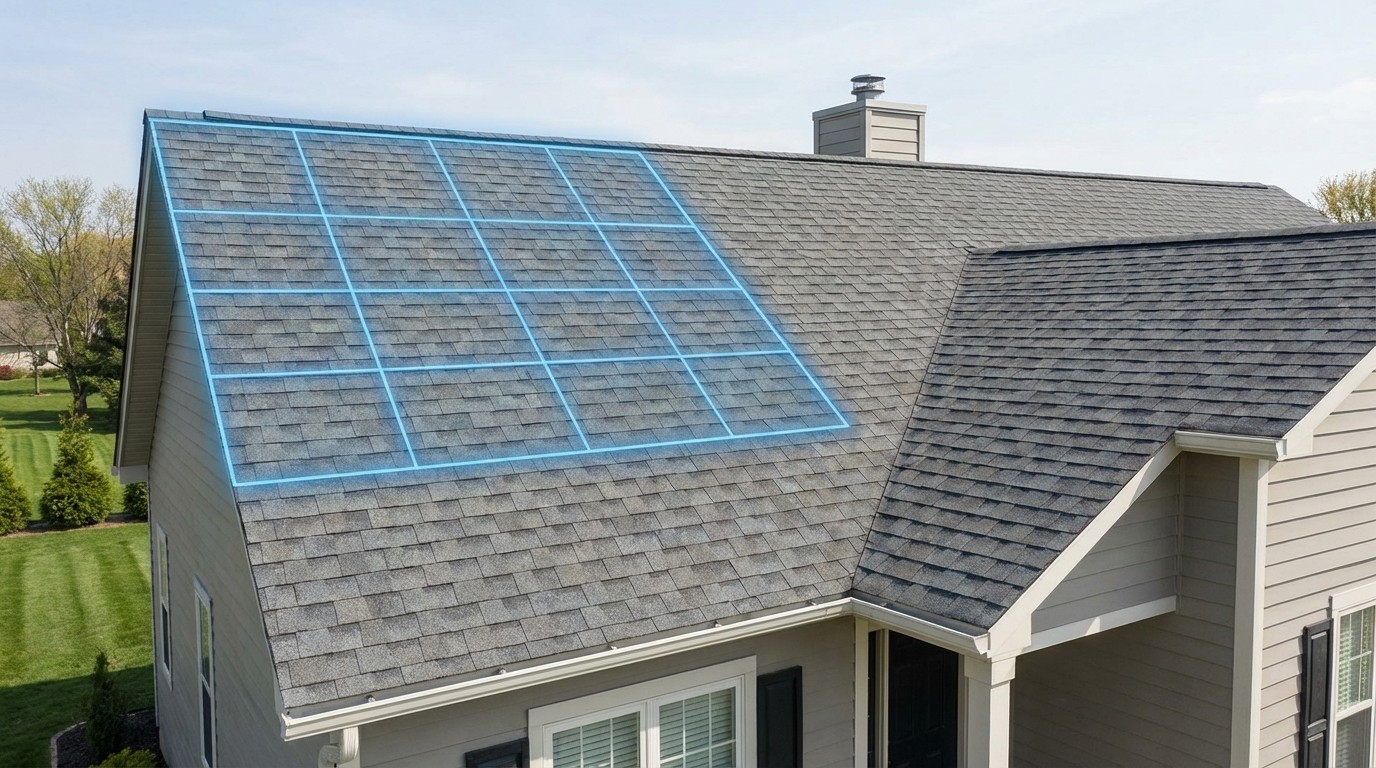
A roofing square is a standard unit of measurement in the roofing industry equal to 100 square feet. It represents a 10-foot by 10-foot area of roof surface. Contractors use squares to calculate materials and provide estimates, making it easier to communicate project scope and pricing across the industry.
This guide explains what a square in roofing terms means, how to calculate the number of squares your roof has, and why understanding this measurement protects your wallet when comparing quotes.
The Simple Definition: What is a Square in Roofing Terms?
A roofing square equals 100 square feet of roof surface. Think of it as a 10-foot by 10-foot section of your roof.
The industry standardized this measurement decades ago to simplify material ordering and pricing. Instead of saying "your roof is 2,500 square feet," contractors say "your roof is 25 squares." It is cleaner and makes the math easier when ordering materials like shingles, which are packaged to cover squares.
Here is a quick example. If your roof measures 2,000 square feet total, that equals 20 roofing squares (2,000 ÷ 100 = 20).
You will also see the abbreviation "sq" used in quotes and material lists. When a contractor writes "23 sq," they mean 23 squares, or 2,300 square feet of roof surface.
Understanding this basic definition is the first step to reading your roofing estimate clearly and comparing multiple quotes side by side.
Why Do Roofers Use Squares Instead of Square Feet?
Contractors use roofing squares for three practical reasons: material packaging, pricing simplification, and industry standardization.
Material Packaging
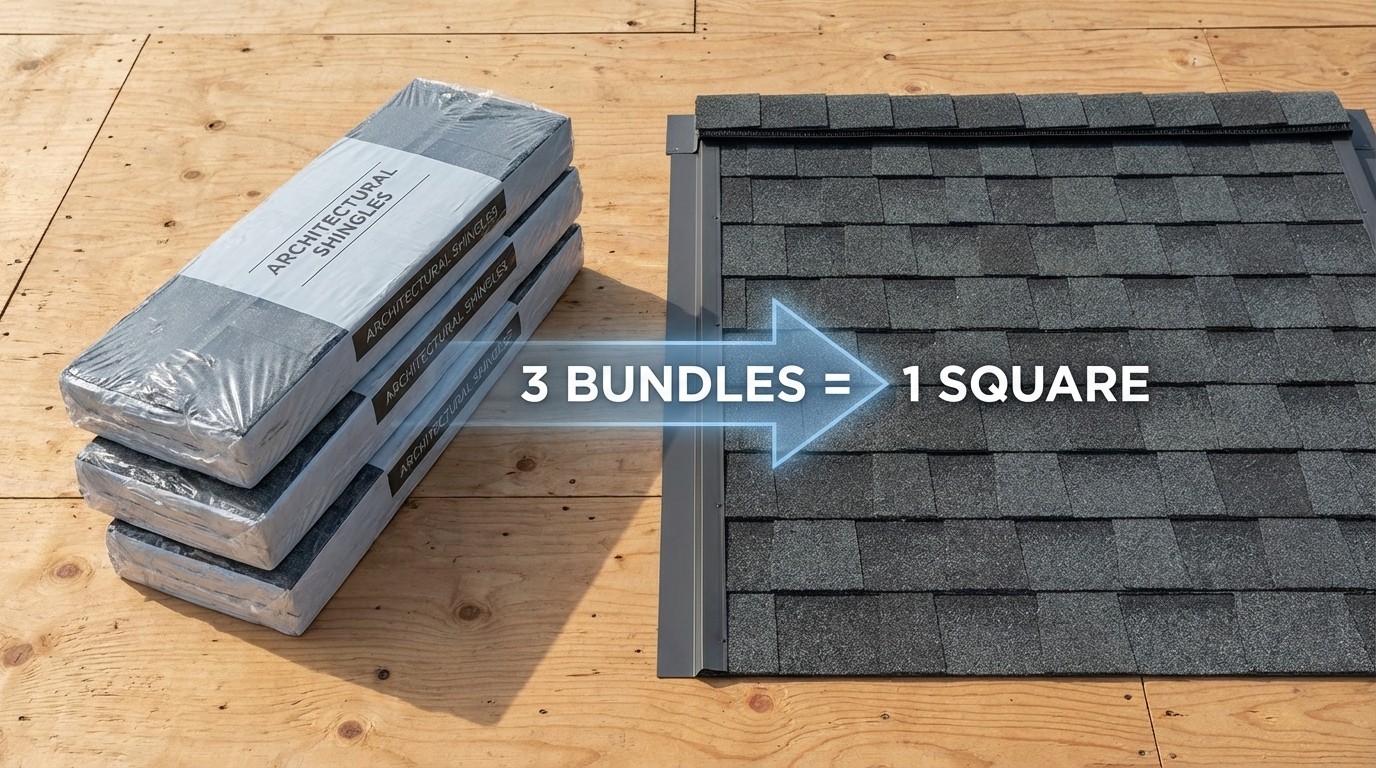
Most roofing materials are designed and packaged to cover squares. For asphalt shingles, the most common roofing material, three bundles typically cover one square. This packaging makes ordering straightforward. If your roof is 24 squares and you are using standard architectural shingles, you need 72 bundles (24 squares × 3 bundles per square).
Metal roofing panels, tiles, and even flat roofing membranes follow similar square-based packaging. Manufacturers know contractors think in squares, so they design products around that measurement.
Pricing Simplification
Quoting "$450 per square" is easier than saying "$4.50 per square foot." Both mean the same thing, but the per-square pricing reduces confusion and makes quotes cleaner.
When you see line-item pricing broken down by the square, you can quickly calculate total costs and compare different material options. A premium shingle at $600 per square versus a standard option at $500 per square shows the upgrade cost clearly.
Industry Standard [1]
The roofing square has been the standard unit across the United States for over a century. This universal measurement lets homeowners compare quotes from different contractors without converting units or doing complex math.
When you request quotes from multiple roofers, they will all measure and price using squares. This consistency makes your job easier when comparing bids and verifying measurements.
What Does "Per Square" Mean in Roofing Pricing?
This is where homeowners often get confused. "Per square" and "per square foot" sound similar but mean very different things.
When a contractor quotes "$500 per square," they mean $500 for each 100 square feet of roof. That breaks down to $5 per square foot ($500 ÷ 100 = $5/sq ft).
If you mistakenly think "$500 per square" means $500 per square foot, a 2,000-square-foot roof would seem to cost $1,000,000 instead of the actual $10,000. That confusion causes sticker shock and makes quotes seem wildly inconsistent.
Chattanooga Pricing Benchmarks (2026)
Here is what homeowners in Chattanooga typically pay per square for asphalt shingle roofs:
Low-End (3-Tab Shingles): $400 to $450 per square installed ($4.00 to $4.50 per sq ft)
Mid-Range (Architectural Shingles): $500 to $600 per square installed ($5.00 to $6.00 per sq ft)
Premium (High-End Architectural): $650 to $750 per square installed ($6.50 to $7.50 per sq ft)
Metal roofing costs more, typically ranging from $800 to $1,200 per square installed. Tile roofing sits even higher, between $1,000 and $1,500 per square.
These prices include materials, labor, tear-off, disposal, and installation. Per-square pricing helps you see exactly what you are paying for that 100-square-foot section, which makes comparing different material options and contractor quotes straightforward.
How Squares Appear on Line-Item Quotes
A transparent roofing estimate breaks down costs by the square. You should see separate line items for materials, labor, tear-off, and disposal, all calculated per square.
Example:
Materials: 25 squares × $150/sq = $3,750
Labor: 25 squares × $250/sq = $6,250
Tear-off/Disposal: 25 squares × $50/sq = $1,250
Total: $11,250
This transparency lets you verify the math and understand where your money goes. If one contractor charges $800 per square while others quote $500, you can dig into the line items to see if the higher price reflects better materials, longer warranties, or inflated costs.
If you want help understanding the details in your quotes, check out our guide on how to read a roof estimate.
How to Calculate the Number of Squares Your Roof Has
You can estimate your roof's square count using two methods: a quick ballpark calculation or a detailed measurement for verification.
Method 1: Simple Home Footage Estimate (Quick Ballpark)
The fastest way to estimate your roof size is multiplying your home's square footage by a pitch multiplier.
Formula: Home square footage × 1.3 to 1.5
Example: A 2,000-square-foot home × 1.4 = 2,800 sq ft of roof ÷ 100 = 28 squares
This method works for initial budgeting but has limitations. It does not account for roof pitch, complexity, overhangs, or detached structures like garages. Use it to get a rough idea, not a final estimate.
Method 2: Accurate Measurement (For Verification)
If you want to verify a contractor's measurement or get a more precise count, follow these four steps.
Step 1: Measure Your Home's Footprint
Start by measuring the length and width of your home's ground-level footprint. For a simple rectangular home, multiply length × width.
If your home has a complex shape with wings, additions, or L-sections, break it into rectangles and measure each section separately. Add them together for total footprint square footage.
Example: A home measuring 50 feet by 40 feet has a 2,000 sq ft footprint.
Step 2: Apply Pitch Multiplier
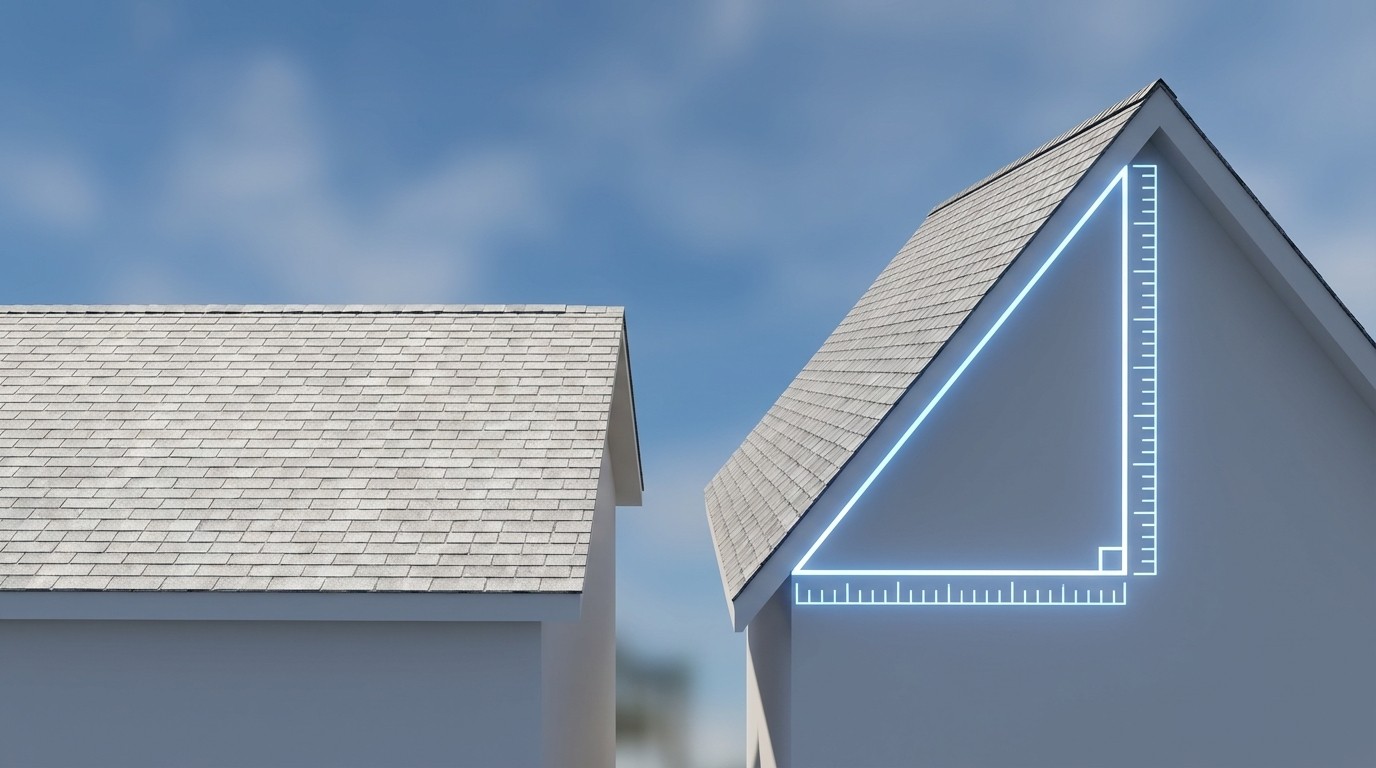
Roof pitch (also called slope) affects the actual surface area. A steep roof has more surface area than a flat roof covering the same footprint.
Pitch is measured as rise over run. A 6/12 pitch means the roof rises 6 inches for every 12 inches of horizontal distance.
Pitch Multipliers:
Low pitch (4/12 or less): 1.0 to 1.1 multiplier
Medium pitch (5/12 to 7/12): 1.2 to 1.3 multiplier
Steep pitch (8/12 to 12/12): 1.4 to 1.6 multiplier
Example: A 2,000 sq ft footprint with a 6/12 pitch (medium) uses a 1.3 multiplier.
2,000 × 1.3 = 2,600 sq ft of roof surface.
Step 3: Add Complexity Factors
Roof features like dormers, valleys, hips, and multiple planes increase surface area beyond the basic footprint and pitch calculation.
Complexity Adjustments:
Dormers and valleys: Add 10% to 15%
Multiple roof planes: Add 5% to 10%
Detached garage or porch: Measure separately and add
Example: A roof with two dormers and one hip section gets a 12% complexity increase.
2,600 sq ft × 1.12 = 2,912 sq ft
Step 4: Divide by 100 to Get Squares
Take your final square footage and divide by 100.
Example: 2,912 sq ft ÷ 100 = 29.12 squares
Round up when ordering materials. In this case, you would order materials for 30 squares to ensure you have enough.
When to Measure Yourself vs. Hire a Professional
DIY measurement works fine for initial budgeting and verification checks. It helps you spot major discrepancies if one contractor claims your roof is 35 squares while others say 25.
However, professional measurement is necessary for final quotes, complex roofs with multiple levels, and steep-pitch roofs where safety is a concern. Experienced roofers use more precise methods and account for details like overhangs, valleys, and waste factors that affect material needs.
The best approach is getting multiple quotes from vetted contractors. When three or four pros measure your roof and provide similar square counts, you know the measurements are accurate. If one contractor's count differs significantly, request a detailed breakdown of how they calculated it.
Getting up to 5 vetted quotes through roofquotes.com helps verify measurements while comparing pricing. Multiple professional measurements catch errors and give you confidence in the true size of your roof.
Understanding Bundles Per Square (Material Calculations)
Once you know your roof's square count, the next question is how many bundles of shingles you need.
The Standard Rule
For asphalt shingles, three bundles typically equal one square. Each bundle covers approximately 33.3 square feet, so three bundles cover the full 100 square feet. This is the standard for many popular architectural shingles, including GAF Timberline HDZ, Owens Corning Duration, and CertainTeed Landmark.
This ratio applies to most standard asphalt shingles, but variations exist based on shingle type and thickness.
Bundles by Shingle Type
3-Tab Shingles: 3 bundles per square
These basic shingles are thinner and lighter, making the 3-bundle-per-square ratio standard.
Standard Architectural Shingles: 3 to 4 bundles per square
Architectural shingles are thicker and heavier than 3-tab. Most standard architectural lines still use 3 bundles per square, but some premium options require 4.
Premium Architectural Shingles: 4 to 5 bundles per square
High-end architectural shingles with extra thickness and dimension often need more bundles to cover a square.
Luxury/Designer Shingles: 4 to 6 bundles per square
The thickest, most dimensional shingles require the most material to achieve their premium look.
Waste Factor
Roofing projects always require extra material beyond the calculated square count. Waste comes from cuts around valleys, hips, chimneys, and vents. Starter strips along the eaves and ridge caps also add to material needs.
Standard practice is ordering 10% to 15% extra beyond your calculated squares. This waste factor ensures you have enough material to complete the job and a few extra shingles for future repairs.
Example: A 25-square roof needs 75 bundles of standard shingles (25 × 3). Adding 10% waste means ordering 83 bundles total (75 × 1.10 = 82.5, rounded to 83).
Verifying Material Counts in Quotes
When reviewing quotes, check that bundle counts match square counts at the appropriate ratio. If a contractor claims your 20-square roof needs 100 bundles of standard architectural shingles, that is a red flag. The correct amount is 60 bundles (20 × 3), plus waste (66 to 69 bundles total).
Significant overages in material counts can indicate padding or errors in the estimate. Our free quote review tool helps spot these discrepancies before you sign a contract.
How Understanding Squares Helps You Compare Roofing Quotes
Knowing what a roofing square is gives you power when evaluating multiple bids.
Apples-to-Apples Comparison
When all your quotes measure your roof in squares, you can compare pricing fairly. If three contractors quote 24 to 25 squares and one quotes 30, you know something is off with that outlier measurement.
Square-based pricing also lets you compare material options within the same quote. If a contractor offers architectural shingles at $550 per square or premium shingles at $700 per square, you can quickly see the $150-per-square upgrade cost. Multiply by your square count (let's say 25 squares) and you know the premium option costs $3,750 more.
Spotting Measurement Discrepancies
If you get quotes with vastly different square counts, request measurement breakdowns. Ask contractors to show their footprint calculation, pitch multiplier, and complexity adjustments.
A variance of 1 to 2 squares on a 25-square roof is normal due to rounding and different measurement approaches. A variance of 5+ squares is a red flag worth investigating.
Verification Methods
Request that contractors explain their measurement methodology. Professional roofers should be able to walk you through how they arrived at their square count.
Some contractors use satellite measurement tools that calculate roof surface area from aerial imagery. Others measure on-site using lasers or traditional tape measures. Both methods work, but if two contractors use the same method and get wildly different results, one made an error.
Red Flags to Watch For
Refusing to Show Square Calculation: A contractor who will not explain how they measured your roof is hiding something.
Vastly Different Square Counts: One contractor saying 30 squares when others say 24 means someone measured incorrectly or is inflating the estimate.
Charging Per Square Foot Instead of Per Square: This pricing method is uncommon in roofing and can be a confusion tactic to obscure true costs.
No Breakdown, Just a Total Lump Sum: Transparent quotes show material, labor, and disposal costs per square. Lump-sum pricing makes verification impossible.
Using Multiple Quotes to Your Advantage
Getting 5 competitive quotes does more than show price differences. It verifies measurements through multiple independent assessments.
When four contractors measure your roof at 24 to 25 squares and one says 30, you know the outlier is wrong. When three contractors quote $500 to $550 per square and one quotes $800, you can ask what justifies the premium or eliminate that bid as overpriced.
Our platform connects you with up to 5 vetted, local roofers who submit line-item quotes showing square counts and per-square pricing. Your money stays protected in escrow until you approve completed work, and because contractors do not pay sales commissions, you typically save 15% to 20% compared to traditional lead-generation sites.
Get your quotes to see what local Chattanooga roofers charge per square for your project.
Chattanooga-Specific Pricing: What to Expect Per Square in 2026
Local pricing helps you set realistic budget expectations and spot outlier bids.
Asphalt Shingles (Most Common)
3-Tab Shingles: $350 to $450 per square installed
The most budget-friendly option, though manufacturers are phasing out 3-tab shingles in favor of architectural options.
Architectural Shingles: $450 to $600 per square installed
The most popular choice for Chattanooga homeowners, offering better durability, wind resistance, and curb appeal than 3-tab.
Premium Architectural Shingles: $600 to $750 per square installed
High-end architectural shingles with enhanced warranties, impact resistance, and dimensional appearance.
Other Roofing Materials
Metal Roofing: $800 to $1,200 per square installed
Standing seam metal roofs offer 40+ year lifespans but cost significantly more upfront.
Tile Roofing: $1,000 to $1,500 per square installed
Concrete or clay tile roofs provide excellent durability and distinctive aesthetics at premium pricing.
Example Cost Breakdown (25-Square Roof, Architectural Shingles)
Materials: 25 squares × $150/sq = $3,750
Labor: 25 squares × $250/sq = $6,250
Tear-Off/Disposal: 25 squares × $50/sq = $1,250
Total: $11,250
This example uses mid-range architectural shingles at $550 per square installed ($150 materials + $250 labor + $50 disposal). Your actual costs vary based on roof pitch, accessibility, complexity, material choice, and contractor pricing.
Factors Affecting Per-Square Costs
Roof Pitch: Steep roofs increase labor time and safety requirements, raising per-square labor costs.
Accessibility: Multi-story homes or roofs with difficult access cost more due to additional setup and safety equipment.
Complexity: Dormers, valleys, hips, and skylights increase labor time and material waste, raising total costs.
Material Choice: Premium shingles, upgraded underlayment, and enhanced warranties increase per-square material costs.
Permit Fees: Chattanooga requires permits for roof replacements, adding a flat fee to your project.
Understanding local pricing per square helps you evaluate whether quotes fall within reasonable ranges or if a contractor is significantly overcharging.
You can also use our roofing calculator to estimate costs based on your roof size and material preferences.
Get Multiple Quotes and Verify Your Roof Measurements
Understanding what a roofing square is gives you the foundation to read estimates clearly, compare quotes fairly, and verify that contractors measured your roof accurately.
Here is what you learned:
A roofing square equals 100 square feet (a 10×10 area).
Contractors use squares to standardize material ordering and pricing.
"Per square" pricing means per 100 square feet, not per single square foot.
You can estimate roof squares by multiplying home square footage by 1.3 to 1.5, but professional measurement is more accurate.
Most asphalt shingles require 3 bundles per square, plus 10% to 15% waste.
6.comparing multiple quotes helps verify accurate square counts and fair pricing.
You now understand the language contractors use. You can confidently ask questions, spot discrepancies in measurements, and evaluate whether pricing falls within reasonable ranges for Chattanooga.
Next Steps
The best way to ensure accurate measurements and fair pricing is getting multiple quotes from vetted professionals. When three to five contractors independently measure your roof and provide similar square counts, you know the measurements are correct.
Request line-item breakdowns showing per-square pricing for materials, labor, and disposal. This transparency lets you compare quotes fairly and understand exactly where your money goes.
Ready to see what your roof costs per square? Get up to 5 vetted, line-item quotes from Chattanooga roofers. Your money stays protected in escrow until the job is done right, and our Million Dollar Guarantee gives you peace of mind throughout the project.
Understanding roofing squares is just the first step. Armed with multiple competitive quotes, you will make an informed decision and avoid overpaying for your roof replacement.